Sunday, September 14, 2014

Ethiopian Activists Fight US-Backed Land Seizures | Nation

(
Ethiopians of the Oromo ethnic group stage a protest against the ruling government. (Reuters/Darrin Zammit Lupi)

Ethiopians of the Oromo ethnic group stage a protest against the ruling government. (Reuters/Darrin Zammit Lupi)
By Hilary Matfess and Foreign Policy In Focus)
September 12, 2014, Nairobi, Kenya (The Daily Nations) — Yehun and Miriam have little hope for the future.
“We didn’t do anything and they destroyed our house,” Miriam told me. “We are appealing to the mayor, but there have been no answers. The government does not know where we live now, so it is not possible for them to compensate us even if they wanted.”
Like the other residents of Legetafo—a small, rural town about twenty kilometers from Addis Ababa—Yehun and Miriam are subsistence farmers. Or rather, they were, before government bulldozers demolished their home and the authorities confiscated their land. The government demolished fifteen houses in Legetafo in July.
The farmers in the community stood in the streets, attempting to prevent the demolitions, but the protests were met with swift and harsh government repression. Many other Oromo families on the outskirts of Ethiopia’s bustling capital are now wondering whether their communities could be next.
These homes were demolished in order to implement what’s being called Ethiopia’s “Integrated Master Plan.” The IMP has been heralded by its advocates as a bold modernization plan for the “Capital of Africa.”
The plan intends to integrate Addis Ababa with the surrounding towns in Oromia, one of the largest states in Ethiopia and home to the Oromo ethnic group—which, with about a third of the country’s population, is its largest single ethnic community. While the plan’s proponents consider the territorial expansion of the capital to be another example of what US Secretary of State John Kerry has called the country’s “terrific efforts” toward development, others argue that the plan favors a narrow group of ethnic elites while repressing the citizens of Oromia.
“At least two people were shot and injured,” according to Miriam, a 28-year-old Legetafo farmer whose home was demolished that day. “The situation is very upsetting. We asked to get our property before the demolition, but they refused. Some people were shot. Many were beaten and arrested. My husband was beaten repeatedly with a stick by the police while in jail.”
Yehun, a 20-year-old farmer from the town, said the community was given no warning about the demolitions. “I didn’t even have time to change my clothes,” he said sheepishly. Yehun and his family walked twenty kilometers barefoot to Sendafa, where his extended family could take them in.
The Price of Resistance
Opponents of the plan have been met with fierce repression.
“The Integrated Master Plan is a threat to Oromia as a nation and as a people,” Fasil stated, leaning forward in a scuffed hotel armchair. Reading from notes scribbled on a sheet of loose-leaf notebook paper, the hardened student activist continued: “The plan would take away territory from Oromia,” depriving the region of tax revenue and political representation, “and is a cultural threat to the Oromo people living there.”
A small scar above his eye, deafness in one ear and a lingering gastrointestinal disease picked up in prison testify to Fasil’s commitment to the cause. His injuries come courtesy of the police brutality he encountered during the four-year prison sentence he served after he was arrested for protesting for Oromo rights in high school and, more recently, against the IMP at Addis Ababa University.
Fasil is just one of the estimated thousands of students who were detained during university protests against the IMP. Though Fasil was beaten, electrocuted and harassed while he was imprisoned last May, he considers himself lucky. “We know that sixty-two students were killed and 125 are still missing,” he confided in a low voice.
The students ground their protests in Ethiopia’s federal Constitution. “We are merely asking that the government abide by the Constitution,” Fasil explained, arguing that the plan violates at least eight constitutional provisions. In particular, the students claim that the plan violates Article 49(5), which protects “the special interest of the State of Oromia in Addis Ababa” and gives the district the right to resist federal incursions into “administrative matters.”
Moreover, the plan presents a tangible threat to the people living in Oromia. Fasil and other student protesters claimed that the IMP “would allow the city to expand to a size that would completely cut off West Oromia from East Oromia.” When the plan is fully implemented, an estimated 2 million farmers will be displaced. “These farmers will have no other opportunities,” Fasil told me. “We have seen this before when the city grew. When they lose their land, the farmers will become day laborers or beggars.”
Winners and Losers
The controversy highlights the disruptive and often violent processes that can accompany economic growth. “What is development, after all?” Fasil asked me.
Ethiopia’s growth statistics are some of the most impressive in the region. Backed by aid from the US government, the Ethiopian People’s Revolutionary Democratic Front (EPRDF), the country’s ruling coalition, is committed to modernizing agricultural production and upgrading the country’s economy. Yet there is a lack of consensus about which processes should be considered developmental.
Oromo activists allege that their community has borne a disproportionate share of the costs of development. Advocates like Fasil argue that the “development” programs of the EPRDF are simply a means of marginalizing the Oromo people to consolidate political power within the ruling coalition.
“Ethiopia has a federalism based on identity and language,” explained an Ethiopian political science professor who works on human rights. Nine distinct regions are divided along ethnic lines and are theoretically granted significant autonomy from the central government under the 1994 Constitution. In practice, however, the regions are highly dependent on the central government for revenue transfers and food security, development and health programs. Since the inception of Ethiopia’s ethno-regional federalism, the Oromo have been resistant to incorporation in the broader Ethiopian state and suspicious of the intentions of the Tigray ethnic group, which dominates the EPRDF.
As the 2015 elections approach, the Integrated Master Plan may provide a significant source of political mobilization. “The IMP is part of a broader conflict in Ethiopia over identity, power and political freedoms,” said the professor, who requested anonymity.
American Support
Standing in Gullele Botanic Park in May, Secretary of State Kerry was effusive about the partnership between the United States and Ethiopia, praising the Ethiopian government’s “terrific support in efforts not just with our development challenges and the challenges of Ethiopia itself, but also…the challenges of leadership on the continent and beyond.”
Kerry’s rhetoric is matched by a significant amount of US financial support. In 2013, Washington allocated more than $619 million in foreign assistance to Ethiopia, making it one of the largest recipients of US aid on the continent.According to USAID, Ethiopia is “the linchpin to stability in the Horn of Africa and the Global War on Terrorism.”
Kerry asserted that “the United States could be a vital catalyst in this continent’s continued transformation.” Yet if “transformation” entails land seizures, home demolitions and political repression, then it’s worth questioning just what kind of development American taxpayers are subsidizing.
The American people must wrestle with the implications of “development assistance” programs and the thin line between modernization and marginalization in countries like Ethiopia. Though the US government has occasionally expressed concern about the oppressive tendencies of the Ethiopian regime, few demands for reform have accompanied aid.
For the EPRDF, the process of expanding Addis Ababa is integral to the modernization of Ethiopia and the opportunities inherent to development. For the Oromo people, the Integrated Master Plan is a political and cultural threat. For the residents of Legetafo, the demolition of their homes demonstrates the uncertainty of life in a rapidly changing country.

Wednesday, June 25, 2014

Aid donors announce investigation into tribal evictions in Ethiopia | Ekklesia

Representatives of some of Ethiopia’s biggest aid donors have announced that they will send a team to the southwest of the country to investigate persistent reports of human rights abuses amongst the tribes living there.
Survival International, the global movement for tribal peoples’ rights, has exposed how the tribal people of the Lower Omo Valley are being persecuted and harassed to force them off their land to make way for cotton, oil palm and sugar cane plantations and many other organisations have published similar reports.
The plantations are made possible by the Gibe III hydroelectric dam, which is itself the subject of huge controversy. The dam, which is nearing completion, will have a serious impact on the livelihoods of 500,000 tribal people, including those living around Kenya’s Lake Turkana. It is also projected to have catastrophic environmental consequences for the region, which is home to renowned UNESCO World Heritage sites on both sides of the border.
Survival and other NGOs have repeatedly denounced the eviction of hundreds of Bodi and Kwegu and continue to receive reports that people are being intimidated into leaving their lands for resettlement camps.
The Ethiopian government has not sought or obtained the indigenous peoples’ free, prior and informed consent to move from their lands, in breach of the guidelines for resettlement drawn up by the Development Assistance Group (DAG), a consortium of the largest donors to Ethiopia, including the US, the UK, Germany and the World Bank. DAG provides significant financial assistance to the local administration responsible for the forced evictions.
DAG has decided to return to the Lower Omo later this year to investigate the situation, even though the evictions continue regardless of past donor visits, the findings of which have often not been published.
This decision follows mounting worldwide concerns. European parliamentarians from Italy, Germany and the UK have asked questions in the European Parliament, and MPs in the UK and Germany have raised their concerns with various ministries. Parliamentary questions have also been tabled in the UK.
In February the US Congress ruled that US taxpayers’ money not be used to fund forced resettlements in Lower Omo.
Following a lawsuit brought by Friends of Lake Turkana, the Kenyan courts have ruled that the Kenyan government must release all information about the deals it has made with Ethiopia about buying electricity generated by the Gibe III dam.
Earlier this year, a UNESCO report recommended that Lake Turkana be inscribed on the List of World Heritage in Danger.

Monday, June 23, 2014

Aid donors announce investigation into tribal evictions in Ethiopia - Survival International


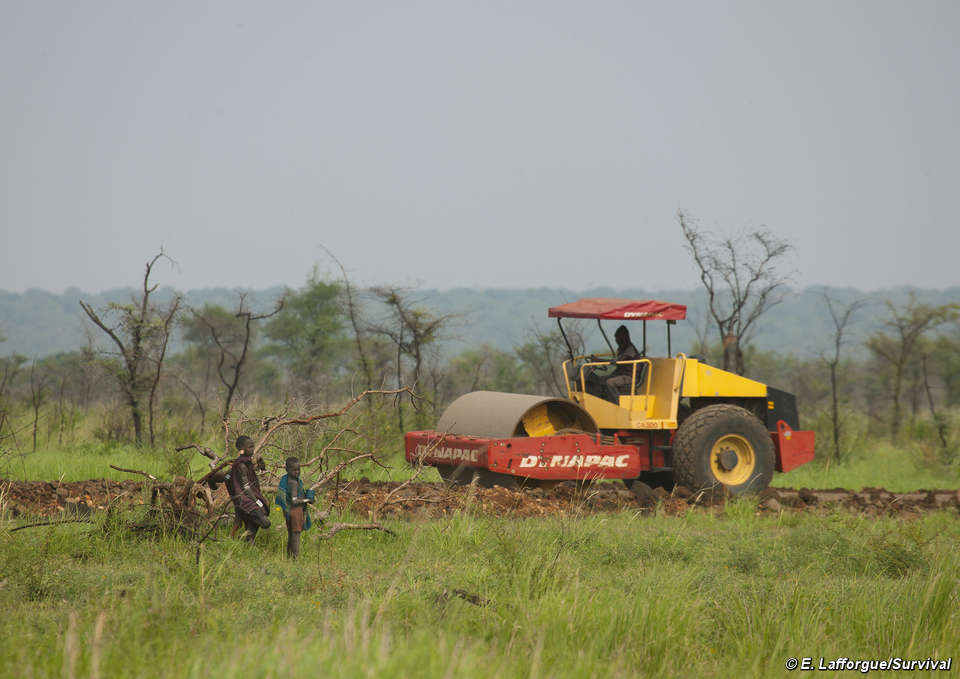
Bulldozers clearing Mursi land in Mago National Park, where communities are being evicted from their land to make way for sugar plantations.

Bulldozers clearing Mursi land in Mago National Park, where communities are being evicted from their land to make way for sugar plantations.
© E. Lafforgue/Survival
Representatives of some of Ethiopia’s biggest aid donors have announced that they will send a team to the southwest of the country to investigate persistent reports of human rights abuses amongst the tribes living there.
Survival International, the global movement for tribal peoples’ rights, has exposed how the tribal people of the Lower Omo Valley are being persecuted and harassed to force them off their land  to make way for cotton, oil palm and sugar cane plantations.
Many other organizations have published similar reports.
The plantations are made possible by the Gibe III hydroelectric dam, which is itself the subject of huge controversy.
The dam, which is nearing completion, will have a serious impact on the livelihoods of 500,000 tribal people, including those living around Kenya’s Lake Turkana.
It is also projected to have catastrophic environmental consequences for the region, which is home to renowned UNESCO World Heritage sites on both sides of the border.
Survival and other NGOs have repeatedly denounced the eviction of hundreds of Bodi and Kwegu and continue to receive reports that people are being intimidated into leaving their lands for resettlement camps.
Daasanach are being forced off their land to make way for infrastructure development such as this giant pump at Omorate, which will facilitate irrigation of the plantations.

Daasanach are being forced off their land to make way for infrastructure development such as this giant pump at Omorate, which will facilitate irrigation of the plantations.
© E. Lafforgue/Survival
The Ethiopian government has not sought or obtained the indigenous peoples’ free, prior and informed consent to move from their lands, in breach of the guidelines for resettlement drawn up by the Development Assistance Group (DAG), a consortium of the largest donors to Ethiopia, including the US, the UK, Germany and the World Bank.
DAG provides significant financial assistance to the local administration responsible for the forced evictions.
DAG has decided to return to the Lower Omo later this year to investigate the situation, even though the evictions continue regardless of past donor visits, the findings of which have often not been published.
This decision follows mounting worldwide concerns. European parliamentarians from Italy , Germany  and the UK  have asked questions in the European Parliament, and MPs in the UK and Germany have raised their concerns with various ministries. Parliamentary questions  have also been tabled in the UK.
Following a lawsuit brought by Friends of Lake Turkana, the Kenyan courts have ruled that the Kenyan government must release all information about the deals it has made with Ethiopia about buying electricity generated by the Gibe III dam.
Earlier this year, a UNESCO report recommended that Lake Turkana be inscribed on the List of World Heritage in Danger.

Thursday, February 6, 2014

- Ethiopia Land for Sale -- Aljazeera


-----------

As the economy thrives, we examine the plight of Ethiopians forced from their land to make way for foreign investors.

 Last updated: 30 Jan 2014 07:52
Listen to this page using ReadSpeaker
Email Article


Print Article


Share article


Send Feedback
Just a few decades ago, Ethiopia was a country defined by its famines, particularly between 1983-1985 when in excess of half a million people starved to death as a consequence of drought, crop failure and a brutal civil war.

Against this backdrop, it is impressive that in recent years, Ethiopia has been experiencing stellar economic growth. The headline statistics are certainly remarkable: the country is creating millionaires faster than any other in Africa; output from farming, Ethiopia’s dominant industry, has tripled in a decade; the capital Addis Ababa is experiencing a massive construction boom; and the last six years have seen the nation’s GDP grow by a staggering 108 percent.

But it is not all positive news, because for all the good figures there are still plenty of bad ones.

Around 90 percent of the population of 87 million still suffers from numerous deprivations, ranging from insufficient access to education to inadequate health care; average incomes are still well below $1500 a year; and more than 30 million people still face chronic food shortages.

And while there are a number of positive and genuine reasons for the growth spurt - business and legislative reforms, more professional governance, the achievements of a thriving service sector - many critics say that the growth seen in agriculture, which accounts for almost half of Ethiopia’s economic activity and a great deal of its recent success, is actually being driven by an out of control ‘land grab', as  multinational companies and private speculators vie to lease millions of acres of the country’s most fertile territory from the government at bargain basement prices.

At the ministry of agriculture in Addis Ababa, this land-lease programme is often described as a "win-win" because it brings in new technologies and employment and, supposedly, makes it easier to improve health care, education and other services in rural areas.

"Ethiopia needs to develop to fight poverty, increase food supplies and improve livelihoods and is doing so in a sustainable way," said one official.

But according to a host of NGO’s and policy advocates, including Oxfam, Human Rights Watch and the Oakland Institute, the true consequences of the land grabs are almost all negative. They say that in order to make such huge areas available for foreign investors to grow foodstuffs and bio-fuels for export - and in direct contravention of Ethiopia’s obligations under international law - the authorities are displacing hundreds of thousands of indigenous peoples, abusing their human rights, destroying their traditions, trashing the environment, and making them more dependent on food aid  than ever before.

"The benefits for the local populations are very little," said renowned Ethiopian sociologist Dessalegn Rahmato. "They’ve taken away their land. They’ve taken away their natural resource, because these investors are clearing the land, destroying the forest, cutting down the trees. The government claims that one of the aims of this investment was to enable local areas to benefit by investing in infrastructure, social services … but these benefits are not included in the contract. It's only left up to the magnanimity of the investor."

And those investors, he continued, are simply not interested in anything other than serving their own needs: "They can grow any crop they want, when they want it, they can sell in any market they want, whether it’s a global market or a local market. In fact most of them are not interested in the local markets.”

He cited as an example a massive Saudi-owned plantation in the fertile Gambella region of south west Ethiopia, a prime target area for investors: "They have 10,000 hectares and they are producing rice. This rice is going to be exported to the Middle East, to Saudi Arabia and other places. The local people in that area don’t eat rice."

But the most controversial element of the government’s programme is known as 'villagisation' - the displacement of people from land they have occupied for generations and their subsequent resettlement in artificial communities.

In Gambella, where two ethnic groups, the Anuaks and the Nuers, predominate, it has meant tens of thousands of people have been forced to abandon a traditional way of life. One such is Moot, an Anuak farmer who now lives in a government village far from his home.

"When investors showed up, we were told to pack up our things and to go to the village. If we had decided not to go, they would have destroyed our crops, our houses and our belongings. We couldn't even claim compensation because the government decided that those lands belonged to the investors. We were scared … if you get upset and say that someone stole your land, you are put in prison. If you complain about being arrested, they will kill you. It's not our land anymore; we have been deprived of our rights."

Despite growing internal opposition and international criticism, the Ethiopian government shows no sign of scaling the programme back. According to the Oakland Institute, since 2008, an area the size of France has already been handed over to foreign corporations. Over the next few years an area twice that size is thought to be earmarked for leasing to investors.

So what does all this mean for the people on the ground? In Ethiopia – Land for Sale, filmmakers Veronique Mauduy and Romain Pelleray try and find out.

People & Power can be seen each week at the following times GMT: Wednesday: 2230; Thursday: 0930; Friday: 0330; Saturday: 1630; Sunday: 2230; Monday: 0930.

Click here for more  People & Power